
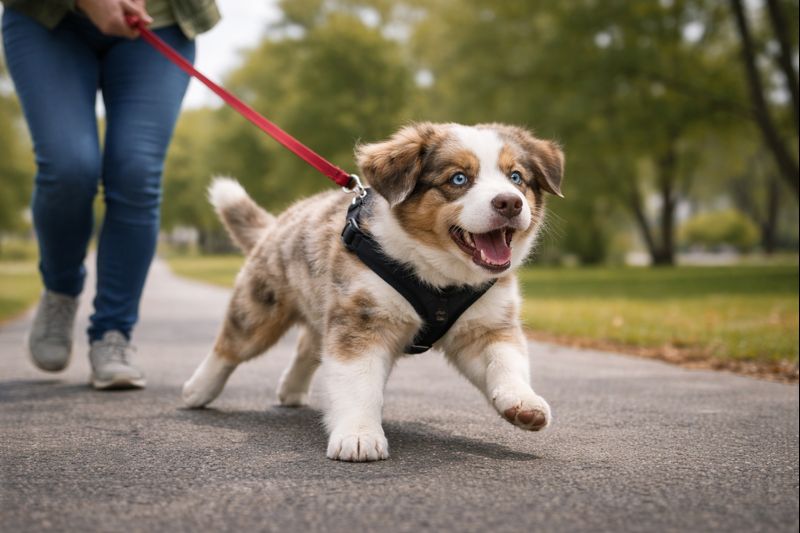
Dog guardians contact me about leash pulling more than almost any other training struggle. They describe sore shoulders, frayed nerves, and walks that feel more like a workout than a pleasure. Many feel embarrassed or frustrated, especially when their dog looks “out of control” compared to others they see out on a walk. What often helps most is for dog guardians to understand why dogs pull on the leash, and why it is not bad behaviour, but a predictable response to the situation we put them in.
When we shift how we view leash pulling, we stop fighting the dog and start solving the problem. That change alone often reduces stress on both ends of the leash.
Walking on a leash challenges dogs from the start
Dogs did not evolve to walk neatly beside humans on a short leash. Humans set the pace, choose the direction, and decide when the walk starts and ends. Dogs experience that arrangement as physically and cognitively demanding.
When a dog pulls on the leash, they usually try to:
- Move at a pace that feels comfortable
- Reach out for information in the environment
- Create distance from something that feels uncomfortable
- Resolve any frustration they may be experiencing
Pulling gives them feedback. If you think about it, it gives them a small amount of freedom. It changes their position, even briefly. That feedback makes sense to the dog, even if it frustrates the person holding the leash.
Once you recognise this, why dogs pull on the leash becomes much easier to understand.
Dogs pull because they want information
Dogs experience the world primarily through scent and taste – their olfactory system. Smells tell them who has been there, what happened, and whether something matters. They sniff, lick and chew things. A walk allows dogs to gather that information.
When a dog pulls towards a scent, a tree, or a patch of grass, they are not ignoring their guardian. They are prioritising information that helps them understand their environment.
Many dogs pull harder when:
- Walks feel rushed
- Sniffing gets interrupted repeatedly
- Routes stay predictable which increase anticipation
Sniffing also helps dogs regulate their nervous systems. When we consistently prevent access to sniffing, dogs often increase their effort. Pulling becomes the tool they use to try to meet that need.
Emotional state drives leash behaviour
A dog’s emotional state strongly influences how well they can walk on a loose leash. Calm, regulated dogs make better choices than dogs who feel overwhelmed or overstimulated.
Dogs often pull more when they feel:
- Over-aroused
- Anxious
- Excited
- Unsure
That explains why a dog may walk beautifully in one location and struggle in another. The skill has not disappeared. The dog’s capacity to use it has changed.
This is another reason why dogs pull on the leash, why it is not bad behaviour, but actually a signal that something in the environment exceeds the dog’s current coping ability.
Pace mismatch creates constant conflict
Most dogs naturally move faster than humans. Young dogs, adolescent dogs, and energetic breeds feel this mismatch even more strongly.
When a guardian consistently restricts a dog’s pace, the dog often responds by leaning into the leash. That behaviour does not reflect stubbornness. It reflects physics and motivation.
Many dogs improve significantly when guardians:
- Shorten walks temporarily
- Add structured sniff breaks
- Use a longer leash in appropriate areas
- Vary routes
These changes reduce pressure and help dogs meet their needs without constant conflict.
Frustration fuels pulling
Frustration plays a major role in leash pulling. Dogs often pull hardest when they can see something they want but cannot reach it.
Common triggers include:
- Other dogs
- People
- Open spaces
- Familiar destinations
When dogs lack skills to disengage calmly, they default to pulling. The leash becomes the barrier, and pulling becomes the solution the dog tries as they’ve probably experienced success with this technique in the past.
Friendly dogs often struggle the most. Their motivation to reach others stays high, and without guidance, pulling fills the gap (I’m looking at you ‘oodles).
Why common advice often backfires
Many people receive advice to fix leash pulling by:
- Tightening the leash
- Using equipment that relies on pain or discomfort
- Repeatedly stopping without teaching alternative behavoiurs
- Expecting instant improvement
These strategies may suppress pulling temporarily, but they rarely teach the dog what to do instead. A tight leash increase frustration. Corrections add stress. Confusion grows.
Dogs learn best when guardians provide clarity, not pressure. When we ignore that, pulling often intensifies rather than improves.
Learning does not transfer automatically
Loose leash walking includes many small skills:
- Staying connected
- Adjusting speed
- Disengaging from distractions
- Responding to changes in leash direction
- Making choices under stimulation
Dogs learn these skills in layers. They do not generalise them automatically to new environments.
This explains why dogs appear “trained” in quiet areas but struggle elsewhere. They have not forgotten. They are still learning.
Recognising this helps guardians stay patient and realistic about progress.
Force-free training supports real change
Force-free approaches focus on:
- Teaching skills gradually
- Supporting emotional regulation
- Reinforcing good choices
- Reducing pressure and stress
When dogs feel safe, they experiment more. They check in. They slow down. They learn that staying connected works.
Corrections may stop behaviour in the moment, but they often damage trust. Over time, they make walks tense rather than enjoyable.
What progress actually looks like
Progress rarely follows a straight line. You may have heard the phrase that ‘success is not linear’. Most guardians notice:
- Good walks followed by difficult ones
- Improvement in familiar places first
- Gradual increases in duration and complexity
These patterns indicate learning, not stubbornness.
When guardians understand why dogs pull on the leash they stay engaged long enough for skills to stick.
The human experience matters too
Being pulled hurts. It frustrates. It can feel unsafe.
Force-free training does not ignore these realities. It aims to support both ends of the leash through:
- Thoughtful equipment choices
- Environment selection
- Skill building
- Clear expectations
Training should reduce stress, not add to it.
A kinder way forward
Leash pulling does not reflect a dog’s character. It reflects unmet needs, skill gaps, and emotional load.
When guardians shift from blame to understanding, progress becomes possible. Most dogs can learn to walk calmly when training addresses the why, not just the behaviour.
That is the heart of understanding why dogs pull on the leash.
You’re not alone
If walking your dog feels like the hardest part of your day, you are not alone. Many dedicated guardians struggle with this exact issue.
You do not need to be firmer.
You do not need to dominate your dog.
You need understanding, patience, and the right skills applied at the right time for both you and your dog.
The goal is not perfection.
The goal is a walk that feels fair, safe, and manageable for everyone involved.
Game On! Let’s Play
Hxx
*Created with the assistance of AI