
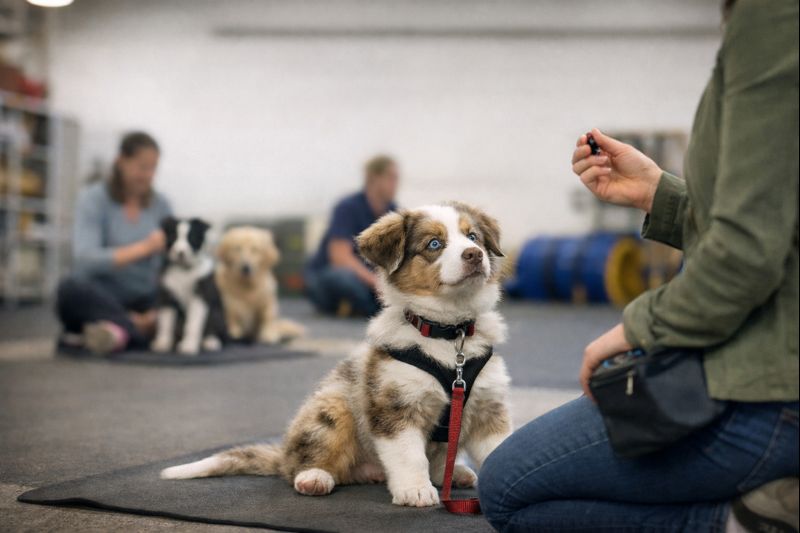
If you have recently brought a puppy home, you have probably already been told that enrolling in puppy class is essential. Friends, breeders, vets, and even strangers at the park are quick to offer advice about where to go and what you should be doing. What is far less commonly discussed is how different puppy classes actually are, and why not all puppy classes are created equal, and choosing the right one matters far more than most people realise.
I work with many dog guardians who did exactly what they believed was the responsible thing. They enrolled their puppy early, attended every session, practised at home, and followed instructions carefully. And yet, weeks or months later, they found themselves feeling uncertain.
That disconnect is not about effort or commitment. It is about whether the puppy class supported the whole puppy behaviours, not just their ability to perform ‘tricks’ in a controlled environment.
Why puppy class matters more than people realise
Puppy class is often treated as a box to tick. Attend for a few weeks, teach the basics, move on. In reality, the early learning experiences your puppy has can shape how they approach the world for years to come.
A puppy class influences:
- How safe a puppy feels in unfamiliar environments
- How they cope with excitement, frustration, and novelty
- How they learn to disengage from distractions
- How they interact with other dogs without being overwhelmed
- How you learn to read, support, and communicate with your dog
- How their future experiences at the veterinary hospital are shaped
When puppy class focuses only on visible obedience behaviours, these deeper skills are often overlooked. That is usually the point where guardians later realise that not all puppy classes are created equal, and choosing the right one matters if they want training to hold up in real life.
Puppy learning is emotional before it is behavioural
One of the biggest misconceptions about puppy training is that behaviour comes first and emotions come later. In reality, it is the other way around.
Puppies learn best when they feel safe, curious, and regulated. If a puppy is overwhelmed, anxious, or over-aroused, learning becomes shallow and fragile. They may be able to ‘perform’ a cue in class but struggle to repeat it anywhere else.
A good puppy class understands that emotional development is not just a side benefit. It is the foundation.
This includes helping puppies learn how to:
- Settle in stimulating environments
- Pause instead of reacting immediately
- Recover after excitement or frustration
- Observe other dogs without needing to interact
These skills are far more predictive of long-term behaviour than how quickly a puppy learns to sit.
What to look for in a good puppy class
Small class sizes that allow real observation
Puppies are not simply small adult dogs. They have immature nervous systems and limited coping capacity. When too many puppies are placed together in a small space, learning often gives way to management.
Smaller classes allow trainers to:
- Watch body language closely
- Adjust activities for different confidence levels
- Step in early before stress escalates
- Support guardians individually
If a class feels busy or rushed, it is worth asking whether learning is actually happening for every puppy and guardian in the room.
A focus on calmness and disengagement
A quality puppy class does not measure success by how excited the puppies are. It measures success by how well puppies can recover from excitement.
This means practising:
- Looking away from distractions
- Choosing to check in with their guardian
- Settling on a mat or bed
- Taking breaks when needed
Puppies who learn these skills early are far more likely to cope with adolescence and adulthood.
Force-free, positive reinforcement methods
Puppies should never be trained using intimidation, physical manipulation, or correction-based techniques. These approaches may suppress behaviour in the moment, but they often create confusion or stress underneath. All this kind of training does is teach them to shut down and damage the relationship they have with their human(s).
Force-free training is not permissive. It is structured, intentional, and evidence-based. It focuses on teaching puppies what to do rather than punishing them for getting it wrong. It shows them how to get it right, setting them up for success.
A good puppy class should be transparent about its methods and happy to explain why they are used.
Real-life skills that matter at home
Puppy class should help with the things that actually affect daily life, such as:
- Mouthing and biting
- Toilet training setbacks
- Jumping up
- Early leash skills
- Settling indoors
If a puppy will often offer behaviours perfectly in class but struggles everywhere else, this shows that the learning has not been generalized and the pup needs more practice in a less stimulating environment.
If a puppy cannot offer an approximation of the behaviour in class then they are likely experiencing overwhelm and will consolidate their learning when the behaviours are practiced at home before attempting to generalise.
This is another point where guardians often realise that not all puppy classes are created equal, and choosing the right one matters beyond the training room.
Socialisation is not about forced interaction
One of the most misunderstood aspects of puppy class is socialisation. Socialisation does not mean allowing puppies to interact freely with every dog and person they meet.
True socialisation is about:
- Exposure without overwhelm
- Choice rather than pressure
- Learning that other dogs exist without needing to engage
Classes that encourage constant interaction can unintentionally teach puppies that calm observation is not an option. This often shows up later as frustration, reactivity, or over-excitement on walks.
A good puppy class prioritises neutrality and calm coexistence.
Red flags worth paying attention to
Some signs that a puppy class may not be the right fit include:
- Large numbers of puppies with minimal individual support
- Language centred around dominance or control
- Pressure for puppies to interact regardless of comfort
- Little explanation given to guardians about why exercises matter
- A focus on speed and performance over understanding
Trust your instincts. If something feels uncomfortable or confusing, it is worth exploring other options.
What you should feel after a good puppy class
After a well-run puppy class, you should leave feeling clearer, not judged. You should understand:
- Why your puppy behaved the way they did
- What is normal for their developmental stage
- What to practise at home and why it matters
That clarity is the real marker of quality. It is also why not all puppy classes are created equal, and choosing the right one matters when you are setting foundations that will carry through adolescence and into adult life.
A gentle reassurance before you go
If you are questioning whether the puppy class you chose was the right one, you are not behind and you have not failed your dog. Puppyhood moves quickly, but learning does not stop when class ends.
Support can be added at any stage, and foundations can always be strengthened.
The goal is not a perfect puppy.
The goal is a confident dog and a guardian who understands how to help them.
Game on! Let’s Play!
Hxx
*Created with the assistance of AI